Introduction — When the Ground Answers the Text
For centuries, the Bible was read primarily as a theological document—revered by believers, questioned by skeptics, and often dismissed by modern critics as a collection of spiritual writings detached from verifiable history. Beginning in the nineteenth century, a new line of inquiry emerged. Archaeologists, linguists, and historians began to turn spades, not sermons, toward the ancient world of the Bible. Cities named in Scripture were excavated, inscriptions were translated, and long-buried cultures re-entered the historical record.¹
What followed was not a single dramatic discovery, but a cumulative pattern. Walls once thought legendary were unearthed. Kings previously considered mythical appeared in royal inscriptions. Peoples, places, and practices described in the biblical text began to align with material evidence from the same eras.²
This reading does not claim that archaeology can “prove” theology. Faith, by its nature, does not rest on excavation reports. Instead, the question is historical: were the biblical writers describing a real world they knew, and does the Bible plainly describe evidence that is found later to be true?
This is the spirit of careful examination seen in Acts 17:11 — not suspicion for its own sake, but a disciplined willingness to search and test what is being claimed.
Footnotes
- J. A. Thompson, The Bible and Archaeology, Eerdmans.
- William G. Dever, What Did the Biblical Writers Know and When Did They Know It?
Archaeology and the Question of History
Modern skepticism toward the Bible often assumes its narratives were written long after the events they describe and therefore reflect legend rather than memory. Archaeology provides a way to test that assumption—not by judging miracles, but by asking whether the authors accurately describe geography, political powers, and cultural realities.³
Archaeology cannot confirm divine meaning. But it can determine whether a text reflects real historical context.
Again and again, the evidence suggests familiarity rather than fiction.
Luke’s introduction in the Gospel openly places his account within investigation, sources, and orderly testimony. Luke 1:1-4
Footnotes
3. K. A. Kitchen, On the Reliability of the Old Testament.
Jericho: A City Once Dismissed
Jericho was long considered a problem for biblical history. Early excavations led some scholars to argue that the city either did not exist at the right time or showed no evidence of sudden destruction.⁴
Later excavations complicated that conclusion. Jericho was indeed fortified. It experienced a sudden destruction. Portions of its wall collapsed outward—an unusual pattern compared to standard siege warfare. Grain stores left intact suggest a short conflict rather than a prolonged siege.⁵
Archaeology does not “prove” Joshua’s account. But it undermines the claim that the account was written by authors unfamiliar with the land.
Footnotes
4. Kathleen Kenyon, Excavations at Jericho.
5. Bryant G. Wood, “Did the Israelites Conquer Jericho?” Biblical Archaeology Review.
The House of David: From Legend to Record
For decades, King David was treated as a symbolic figure. That position became difficult to maintain after the discovery of the Tel Dan Stele (9th century BCE), an Aramaic inscription referring to the “House of David.”⁶
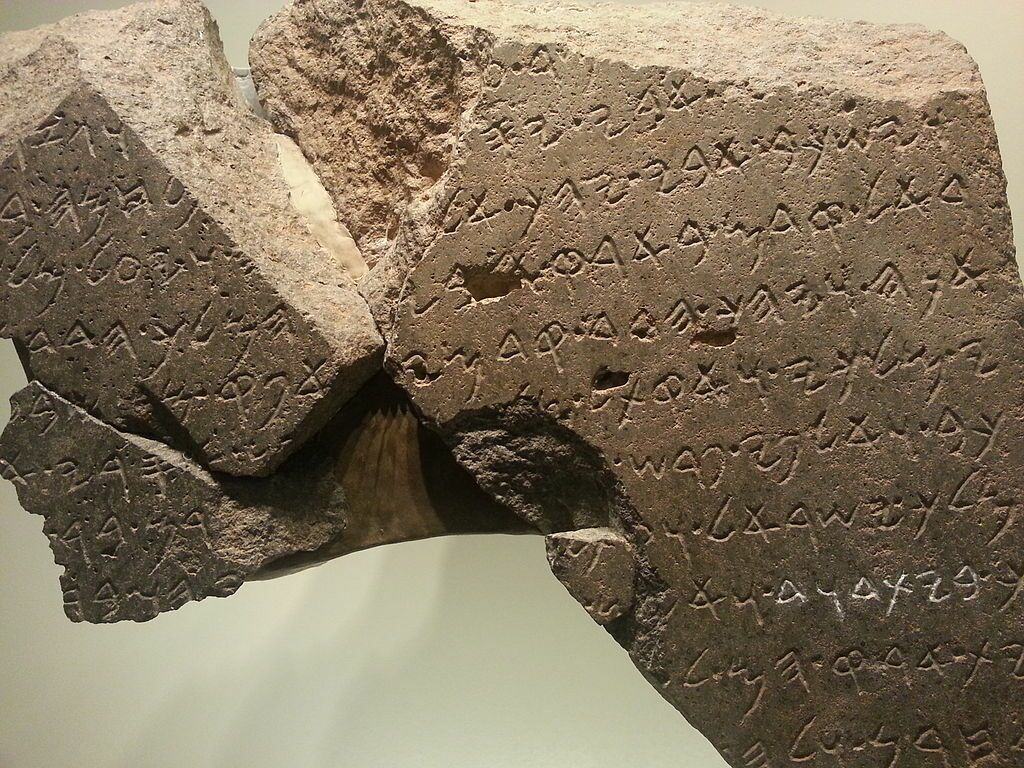
This was not written by a biblical author, but by an enemy king boasting of victory. In ancient inscriptions, dynastic names were not invented lightly—especially not for defeated rivals.
David moved from tradition into documented history.
Footnotes
6. Avraham Biran & Joseph Naveh, “The Tel Dan Inscription,” Israel Exploration Journal.
Pontius Pilate: From Creed to Stone
Pontius Pilate is central to the Gospel accounts, yet for centuries his existence was known primarily through Scripture and later creeds.
In 1961, archaeologists discovered a limestone block at Caesarea Maritima bearing a Latin inscription namingPontius Pilate, prefect of Judea, under Emperor Tiberius.⁷ The title, location, and timeframe match the Gospel accounts precisely.
The significance is historical. The Gospels place Jesus within a real Roman administrative structure—now independently confirmed.
Footnotes
7. Antonio Frova, “L’Iscrizione di Ponzio Pilato,” Rendiconti dell’Accademia Nazionale dei Lincei.
Assyrian, Babylonian, and Persian Records
Assyrian inscriptions reference Israelite kings such as Jehu and Hezekiah and describe military campaigns consistent with the biblical timeline. Babylonian chronicles record the fall of Jerusalem and the exile of Judah.⁸
The Cyrus Cylinder documents Persian policy allowing displaced peoples to return and restore their temples—precisely the framework described in Scripture.⁹
These records were not written to validate the Bible. They were written for imperial purposes. Their convergence with Scripture is therefore historically significant.
Footnotes
8. James B. Pritchard, Ancient Near Eastern Texts Relating to the Old Testament.
9. Amélie Kuhrt, “The Cyrus Cylinder and Achaemenid Imperial Policy,” Journal for the Study of the Old Testament.
When the Bible Touches the Natural World
The Bible is not a science textbook. Yet when it speaks incidentally about the natural world, it often avoids the dominant errors of its time.
Job 26:7 states that God “hangs the earth upon nothing.” Job is commonly dated between 2000–1000 BCE. At the time, most cultures believed the earth rested on pillars, animals, or gods. The biblical text avoids all such explanations.¹⁰
Isaiah 40:22, written around 700–550 BCE, refers to the “circle of the earth.” Aristotle offered observational arguments for a spherical earth around 330 BCE, and Eratosthenes measured Earth’s circumference around 240 BCE.¹¹
The Bible does not explain gravity or geometry. It simply avoids myth.
Footnotes
10. Gerald Schroeder, The Science of God.
11. Aristotle, On the Heavens; Cleomedes, On the Circular Motions of the Celestial Bodies.
The Critical Clarification: Scripture and Scrutiny
This point matters deeply.
The Bible does not make scientific claims. It does not predict equations or propose theories. It does not ask to be judged as a scientific text.
What is remarkable is this:
Writings that predate formal science consistently avoid the dominant scientific errors of their time.
And this matters even more when placed beside scrutiny.
No ancient manuscript has been examined more critically.
No text has been challenged more persistently.
No book has faced more sustained attempts at disproof.
And yet the pattern remains.
Claims once dismissed are revisited.
Assumptions are revised.
Evidence emerges.
The text remains.
The Bible does not prove science.
It survives it.
Truth does not fear scrutiny.
Why This Matters for the Journey
For those coming to inBerea.com, this is not about argument—it is about confidence.
Archaeology does not force belief, but it removes barriers.
Science can not replace God, but it clarifies reality.
History does not create faith, but it grounds it.
The Bible does not ask to be protected from examination.
It asks to be read honestly.
And when it is, time and again, its truth is revealed.